Name-calling, insulting, humiliating, shouting, constant arguing, preventing contact with other people, restricting movement, blackmail, threats, jealousy, taking control, forbidding and commanding, monitoring, following, checking by phone or in other ways, stalking … then you are experiencing psychological violence.Name-calling, insulting, humiliating, shouting, constant arguing, preventing contact with other people, restricting movement, blackmail, threats, jealousy, taking control, forbidding and commanding, monitoring, following, checking by phone or in other ways, stalking … then you are experiencing psychological violence.
Do you think you are too sensitive?
It is right that everyone respects you, takes your wishes and needs into account, and treats you as equal.
No one is allowed to do anything to you that insults you, frightens you, or hurts you.
Do you think you are to blame for the violence you are experiencing?
Violence is the choice of the perpetrator. The person who uses it does so because they want to control you and subjugate you.
A victim of violence is never responsible for the violence they experience.
Do you think you have to endure it?
No one has to suffer violence. No matter what you were taught, what you are told.
Even if you live in difficult life circumstances, you have the option to leave a violent relationship.
Do you still love your partner and hope they will change?
Violence over time becomes a normal part of the relationship; it always becomes worse and more frequent.
Your partner will change only if they accept responsibility for the violence and stop using it.
About Violence
Let’s recognize violence
Domestic violence (including intimate partner violence) is a term used to describe learned patterns of behavior that one partner uses to exercise power and control over the other partner.
Seek help if you are experiencing violence.
Every relationship is different, and violence can appear in various forms, such as:
- your partner tells you that you never do anything well enough;
- your partner is jealous of your female and male friends;
- your partner prevents you from spending time with friends and family;
- your partner insults, humiliates, or ridicules you, even in front of other people;
- your partner blocks your own decisions and restricts you in employment and education;
- your partner controls your or shared finances, takes your money, and does not want to contribute to shared expenses;
- your partner forces you into sexual acts that cause you discomfort, fear, humiliation;
- your partner pressures you to use drugs and alcohol;
- your partner intimidates and controls you with threatening looks and actions;
- your partner insults your parenting abilities, threatens to harm or take away your children or pets;
- your partner threatens you with a weapon or possesses weapons;
- your partner destroys your belongings or your home.
Beating, slapping, kicking, pushing, pulling hair, choking, strangling, injuring with a weapon or threatening with it, burning, drowning … then you are experiencing physical violence.Beating, slapping, kicking, pushing, pulling hair, choking, strangling, injuring with a weapon or threatening with it, burning, drowning … then you are experiencing physical violence.
How can we recognize signs of possessive and controlling behavior?
At the beginning of a relationship, it is difficult to recognize the signs that may later develop into violent behavior. Many partners may seem ideal at first. Signs of violence usually do not appear suddenly, but gradually, and over time they become more frequent and more severe.
Do you find yourself thinking a lot about your partner and trying to anticipate what might upset or trigger them? Are you preoccupied with the thought of everything you must do and how you must behave so that your partner will not explode? Do you try to control your children’s behavior to such an extent that tension and violence will not occur? Are you afraid of spending time with your partner? All of these are strong warning signs that point to a dynamic of domestic violence.
The dynamic of violence is best illustrated by the cycle of violence, within which periods of rising tension, violent outbursts, the perpetrator’s remorse (and thus calming the victim—“he’s not that bad, he also has good moments”) alternate. The cycle is closed with the so-called honeymoon period, and a new cycle inevitably follows with another outburst.
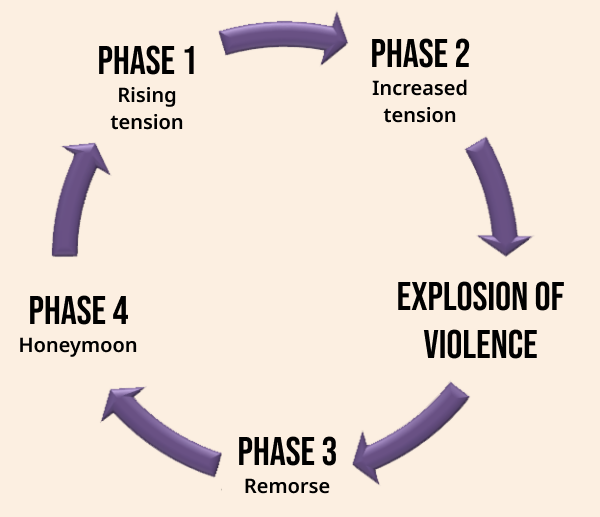
Vir: Prepoznajnasilje.si
Unwanted touching, coercion into sexual intercourse, rape (oral, vaginal, anal), sexual abuse, intrusive verbal sexual advances, sexual harassment, forcing to watch pornography, urging to pose nude, displaying nudity … then you are experiencing sexual violence.Unwanted touching, coercion into sexual intercourse, rape (oral, vaginal, anal), sexual abuse, intrusive verbal sexual advances, sexual harassment, forcing to watch pornography, urging to pose nude, displaying nudity … then you are experiencing sexual violence.
WHY DOES VIOLENCE OCCUR?
The perpetrator wants to achieve the subjugation of the other person. The victim is therefore always in danger, as the perpetrator can turn every action, word, silence, look, etc., against the victim in a way that justifies their violent behavior.
These behavioral patterns manifest through many different actions of the perpetrator, such as: preventing movement/withdrawal/leaving, causing physical pain and injuries, destroying belongings, intimidation and threats, financial control, preventing the victim from earning their own income and accessing resources, manipulating and forcing the partner into certain behaviors or actions, emotional abuse, insults, humiliation, isolating the partner from loved ones, establishing unwanted contacts, stalking, misuse of private photos and recordings, etc.
Perpetrators of violence can use multiple forms of violence simultaneously. Violence is present everywhere, in all environments—regardless of race, nationality, religion, economic status, education, or other circumstances.
Statements from Users
The Law on the Prevention of Domestic Violence defines violence in Article 3 as follows:
(2) Violence is any use of physical, sexual, psychological, or economic violence by one family member (hereinafter: the perpetrator of violence) against another family member (hereinafter: the victim), or the neglect or stalking of the victim, regardless of the age, sex, or any other personal circumstance of the victim or perpetrator of violence, and includes the corporal punishment of children.
Not contributing to the joint family budget, taking income, restricting the ability to earn your own income or forbidding employment, controlling and limiting the use of property/income, restricting basic necessities of life (food, clothing, hygiene products) … then you are experiencing economic violence.Not contributing to the joint family budget, taking income, restricting the ability to earn your own income or forbidding employment, controlling and limiting the use of property/income, restricting basic necessities of life (food, clothing, hygiene products) … then you are experiencing economic violence.
Do you need help?
Are you experiencing violence?
Are you experiencing violence? Seek help. Share your distress with a trusted person or someone you believe can help you: a relative, friend, colleague, doctor, teacher, neighbor. You do not need to suffer. If you do not have a trusted person or want professional help, we are here for you.
You can confide in a professional at the social work center in person, by phone, or by email. A list of social work centers in Slovenia can be found on the website of the Association of Social Work Centers.
Tell your personal doctor or anyone in a healthcare facility about what you are experiencing. Start your path out of violence.
Violence, abuse, shame, guilt, and hopelessness only intensify in isolation. Confide in someone. You are not alone. You can call us anytime.
Do you need help?
Do you notice violence?
Is violence happening to someone close to you? Do you notice signs of violence in your environment? Do you want to start a conversation about violence? Are you unsure what is happening with your neighbors? Do you hear shouting, crying, swearing, noise?
Kadar sumimo, da je oseba žrtev nasilja, lahko povprašamo: “Ali se doma počutite varni?” Večinoma ljudje težko govorimo o problemih doma. Lahko se nam dogajajo tudi stvari, zaradi katerih nas je sram, se počutimo krive, nas je strah. Kako je pri vas?
If we hear, see, or otherwise detect violence, we report it. As reporters, we are not required to investigate or be certain about what is happening or whether the account of the person confiding in us is true. That is the job of the police. When we call the police, we describe exactly what we observed.
Therefore, we should not look away, ignore, or overlook it. Perpetrators count on our silence. The victim counts on our help, as they often cannot stop the violence on their own. Our report can be crucial for starting procedures and ending a dangerous situation.
If a person experiencing violence confides in us, we listen and do not judge their choices and decisions. We cannot save victims of violence, but we can discuss safety with them, support them in leaving a violent relationship, and refer them to institutions and NGOs that can help. We encourage them to stay in contact with us and with other trusted people.